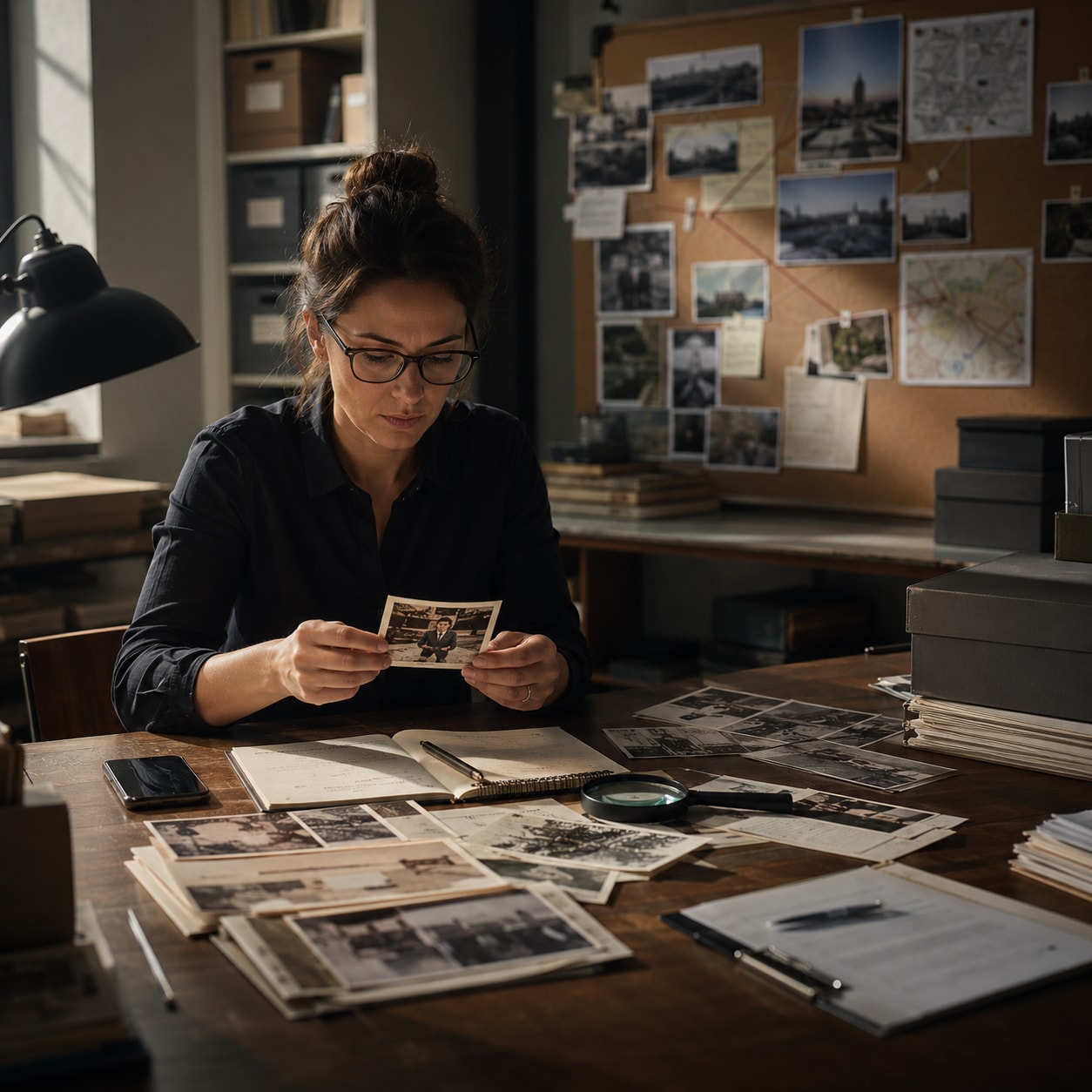
The supplied evidence does not identify or authenticate a specific “Henry Earl image.” Use this evidence-based process to investigate its possible origin, test its surrounding claims, and avoid presenting unresolved details as facts.
What Can—and Cannot—Be Established About the Henry Earl Image
The available sources do not identify a particular “Henry Earl image.” They do not establish an image’s subject, creator, date, location, original caption, publication history, or relationship to credential research. Without that evidence, no image-specific interpretation can be verified.
What the sources do support is a general verification process. The Associated Press describes checking visual material through metadata, timing, location, reverse-image searches, geolocation, comparisons of visible details, manipulation checks, and contact with the original creator. DepositPhotos describes its own reverse-image-search service as a way to search with an image file or URL and find identical or similar visuals in its library.
These methods provide an investigative starting point, not an identification of the image. Until evidence connects a specific file to a reliable origin and corroborates the claim attached to it, treat the image’s identity and meaning as unresolved.
Why an Image or Caption Alone Is Not Enough
A picture and its accompanying caption may present a claim, but they do not independently establish who or what the picture depicts, when it was created, where it was made, or whether its description is accurate. Those conclusions require evidence beyond the visual and the text displayed beside it.
AP says its verification process corroborates facts with documents and on-the-record sources. For visual material, it also examines metadata, timing, and location. Its workflow for user-generated content includes geolocation and comparisons involving landmarks, signage, weather, and language. These checks matter because they test different parts of the surrounding narrative rather than assuming that one clue verifies the whole claim.
Apply that distinction to anything labeled the “Henry Earl image.” The label itself is an unverified claim unless reliable evidence connects it to a specific image and subject. A confident caption, repeated attribution, or visually plausible scene does not replace provenance and corroboration. Record what the image and caption claim, but keep those claims separate from what reliable sources can establish.
Start With a Reverse-Image Search
A reverse-image search uses an image rather than ordinary keywords as the search input. DepositPhotos says its service accepts a reference image file or URL and searches its library for identical or similar visuals. It also describes reverse-image searching as a way to investigate possible picture origin and identify potentially plagiarized content.
If you have access to the image file or its direct URL, use it as the reference input. Review any identical or similar results for information that could help trace an earlier appearance or possible source. Keep a clear distinction between an exact-looking match and a merely similar image.
A result is a lead, not authentication. Finding the same visual elsewhere does not by itself establish which copy came first, whether its caption is correct, or whether the surrounding claim is reliable. AP includes reverse-image searches as only one part of a broader process that also checks metadata, timing, location, visible details, manipulation, and the original creator.
DepositPhotos is a commercial image platform, so its description supports limited statements about how its own search service works. A match in its library should be evaluated with the same wider verification checks rather than treated as independent proof of the “Henry Earl” label or any associated narrative.
Check Provenance, Timing, Location, and Visual Details
Use the verification practices described by AP as a structured checklist:
– Metadata: Examine available metadata for clues relevant to the file’s origin. Treat metadata as one part of the inquiry and compare it with other evidence. – Timing: Test whether the claimed date or time is supported. Do not convert an undated image or unsupported caption into a definite timeline. – Location: Investigate whether the claimed place can be geolocated or otherwise corroborated. – Landmarks and surroundings: Compare identifiable landmarks and other environmental details with reliable information about the proposed location. – Signage and language: Look at visible signs and language for details that support or conflict with the surrounding claim. – Weather: Compare visible conditions with the claimed context when relevant evidence is available. – Manipulation indicators: Inspect the visual for possible alteration. If the material is a video or a sequence of frames, AP’s process includes frame-by-frame checks. – Cross-checking: Consider whether the timing, location, metadata, and visible details point toward the same conclusion.
No single item in this checklist establishes what the unspecified “Henry Earl image” depicts. The supplied package contains neither the image nor image-specific findings from these checks. The appropriate result may therefore remain “unknown.” That is more accurate than filling evidentiary gaps with an assumption.
Corroborate the Claim and Seek the Original Creator
After gathering visual clues, test the claim attached to the image against evidence outside the image itself. AP says it corroborates facts with documents and on-the-record sources. For user-generated material, its verification process can also include contacting the original filmer.
For the material described as the “Henry Earl image,” first separate the questions that need answers: Who is said to be shown? Who created the image? When and where was it made? What was its original caption? Where was it first published? None of those details is established by the supplied sources.
An original creator may be able to clarify authorship, the circumstances in which material was created, and whether permission has been granted. AP’s stated process includes confirming permissions and authorship for user-generated content. Any information obtained from a claimed creator should still be considered alongside documents, on-the-record sources, and the available visual evidence.
If the creator cannot be located or the surrounding claim cannot be corroborated, preserve that uncertainty. Do not turn an attribution into a fact merely because it has been repeated.
Interpret and Share the Image Safely
Base any interpretation on what the verification process actually establishes. If the subject, creator, date, location, caption, or publication history remains unresolved, label it as unknown. Avoid repeating an unsupported identification in a headline, caption, citation, filename, or social post as though it were confirmed.
Before reusing the image, address authorship, permission, and licensing separately from factual verification. AP says it confirms permissions and authorship for user-generated content. DepositPhotos, meanwhile, presents origin investigation and the discovery of licensed alternatives as distinct uses associated with image searching. Locating an identical or similar visual does not itself demonstrate that you have permission to publish it.
A cautious decision framework is:
1. Do not interpret the image as depicting Henry Earl unless reliable evidence establishes that identification. 2. Do not present a claimed date, place, creator, or original caption as settled without corroboration. 3. Do not treat a reverse-image result as complete authentication. 4. Confirm authorship, permission, and applicable licensing before reuse. 5. If essential details remain unresolved, describe the uncertainty or avoid sharing the image with the disputed claim.
The goal is not to force a conclusion. It is to prevent an unverified label or caption from becoming more credible through repetition.
Quick Verification Checklist
Before interpreting, citing, downloading, or sharing the image, check whether you can answer each question with corroborated evidence:
– Do you have the specific image file or a direct URL? – Has a reverse-image search found identical or similar visuals that may help trace its origin? – Have you checked available metadata, timing, and location? – Do landmarks, signage, weather, and language support the claimed context? – Has the visual been examined for possible manipulation, including frame-by-frame review when applicable? – Do documents or on-the-record sources corroborate the attached claim? – Has the original creator been identified or contacted? – Are authorship and permission confirmed? – Is any required license established before reuse? – Are unresolved details clearly labeled as unknown?
For the unspecified “Henry Earl image,” the supplied sources do not complete these checks. Until they are completed with reliable evidence, neither the image’s identity nor its surrounding narrative should be treated as established.
Disclosures and limitations
– This article was prepared with AI assistance from the supplied research package and approved content plan. – The article relies on general verification practices described by the Associated Press and limited descriptions of DepositPhotos’ own commercial reverse-image-search service. Neither supplied source identifies or authenticates a specific “Henry Earl image,” and no image-specific conclusion is offered. – No products are recommended and no affiliate links are included. If a future version adds commercial recommendations or affiliate relationships, those relationships should be disclosed clearly.
Sources
– DOMŮ – RADIO DIXIE — radiodixie.cz – Lord Henry Percy – Wikipedia — en.wikipedia.org – Verification at AP | The Associated Press — The Associated Press – GitHub – requie/LLMSecurityGuide: A comprehensive reference for securing Large Language Models (LLMs). Covers OWASP GenAI Top-10 risks, prompt injection, adversarial attacks, real-world incidents, and practical defenses. Includes catalogs of red-teaming tools, guardrails, and mitigation strategies to help developers, researchers, and security teams deploy AI responsibly. — GitHub – Alan Henry Bio and Latest News, Articles and Reviews — PCMAG – Reverse Image Search — Find Similar Images | DepositPhotos — depositphotos.com – The Rossiters — SMS.cz – Upíří deníky – hudba ze seriálu — SerialZone.cz – 1912 United States House of Representatives elections – Wikipedia — en.wikipedia.org – Earl Doherty – Wikipedia — en.wikipedia.org